A VUCA World Dominates

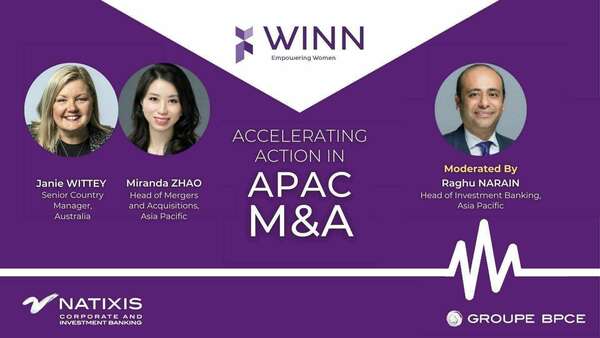
Raghu Narain
Head of Investment Banking, Asia Pacific
Natixis CIB
“VUCA” (Volatility, Uncertainty, Complexity, and Ambiguity) is a theme that has featured regularly in our Investment Mosaic over the years – and this is because of its various effects on the deal environment:
- Volatility arising due to policy actions and geopolitics, especially impacted by the ongoing wars.
- Uncertainty is related to macroeconomic factors, such as rates that are higher for longer, shifting inflation in the US, deflation in China, depreciating currencies, and an overall murky picture on inflation.
- Complexity surrounds economic weaponization, and the fact that companies have to re-shift and rebuild their supply chains as well as the issue of data security.
- Ambiguity around all the above factors leads to a headwind impact on volumes.
This ongoing VUCA environment affects how a buyer and seller look at doing deals in a deal flow context. Buyers and sellers must be fully aware of their environment, which is more complicated geopolitically. There are also more bilateral discussions occurring because investors seek deals which are not subject to wide auctions. In a bilateral situation, investors can conduct price discovery and decide deal structure in a more private format, rather than going out to a wide range of bidders.
Investors are also looking at growth versus resilience, as it's not enough to have growth in this heightened VUCA world. It is important to also examine the resilience of the business, by stress testing the cashflows and your bidding assumptions as a buyer to assess your bid. Integrating resilience into an asset’s lifecycle — climate footprint, tech resilience, and human resilience — is essential for long-term viability, valuation, and adaptation.

AI’s role in the VUCA world
It’s important to examine the whole ecosystem of artificial intelligence (AI) within the VUCA world. In addition to the AI technology itself, there's also a component of data centers, semiconductor chips, land, water, traditional & renewable energy that exists in the physical world. These factors comprise the full ecosystem of the Large Language Model (LLM) AI story, and in many ways, can be limiting in the physical world.
As user adoption continues to accelerate, the use cases become more obvious. Therefore, when investors look at AI or the AI value chain, although valuation seems high, it is juxtaposed with the growth that is happening in the sector, as well as the adoption levels. Other valuations compensate for what an investor considers in terms of growth and adoption.
In Asia Pacific, the data center operators and country incumbents who have access to the above-mentioned inputs like land and power - and sometimes strong access to chips - are forming joint ventures with the big technology companies as customers. There are also large investments going into developing the LLM platforms, and we've seen active cross-border flow between Japan and the US in this area.
Every company is exploring how AI will create better efficiency for them, and this means higher user adoption. Investors see the enormous potential of growth opportunities and how AI fits into sectors, especially healthcare and consumer.
APAC Markets with Growth Opportunity Sets
Japan
Japan is an accelerating story, and it is the largest APAC contributor to the 4 trillion of global annual deal volumes that were announced and closed last year. Underpinning that, are the Japanese government’s corporate reforms that enable transaction flows to happen. Take-privates are becoming more common as there are a lot of undervalued assets and value to be unlocked in these large corporations that have multiple business lines. Dealmakers can unlock this value and do carve outs – and these types of deals are happening regularly.
The cash that is sitting on the balance sheet of companies is also an attractive feature to acquire a target in Japan, which leads to a large opportunity set for private equity and infra funds. Private equity and infra funds write big equity checks, particularly the global ones in a large market like Japan. Japanese public markets are trading at a reasonable valuation of price to earnings of around 14 to 15 times in the public market, so there can be undervalued assets to be bought.
India
The India market is still in the Goldilocks zone and will continue to be there for a while. We predict India to grow at about 6.0+%. GDP growth this year. The strongest driver of Indian growth is its demographics. The younger population are earning strong wages and can propel the consumer sector. The infrastructure that the government has built enables commerce, along with technology overlay.
The reality of Indian deal flow is that it presents very strong growth opportunity, but it's also a market that has matured over time. Now that the IPO market has become more mature, private equity firms are doing exits. They are also able to sell assets to other private equity investors, because there's enough critical mass of investors now entering the country.
In terms of outbound investment for India, we see a lot of Indian healthcare companies that have reached a market saturation level and are looking for growth by acquiring assets in Europe or the US. There are examples of big outbound deals happening, especially in healthcare. In terms of inbound investment, valuations are high, so purchase entry price matters. Public price to earnings in India is still higher than the rest of the world, however there is inbound activity in the consumer space, energy transition, data centers, infrastructure, financial institutions, and business services.
China
15 years ago, Chinese privately owned enterprises and state-owned enterprises went on an acquisition spree in their respective sectors. Some of these synergies have not yet been realized, and it’s complicated to manage cross border acquisitions, post the acquisition, given the distances and the cultural nuances. Therefore, there is a need to raise liquidity to deploy it in the domestic Chinese market, where some owners have an incumbent advantage to be able to play consolidator. In a way, it's refocusing back into a large addressable market in China, as opposed to spreading outside in Europe and the US, taking the burden of the cross-border merger integrations.
Growth and Resilience Key for Companies in the VUCA world
There is a lot of deal flow demand from CEOs and Boards to gain scale and efficiency through deals. Private equity needs to divest because they have to start returning capital to LPs. The issue is the headwind that we get from the VUCA world, which creates a valuation gaps. Because there's so much uncertainty and heightened risk, the cost of funding has also gone up.
With the Middle East escalations, there will be an even higher level of VUCA affecting the headwind on M&A deal flow. With the shifting supply chain, investors are going to take a wait-and-see approach when it comes to dealmaking, and ensure they are buying the right asset in the context of a new supply chain. There will be a lot of redrafting and people will go back to the blueprint.
With oil at a recent all-time high, companies will rely more on renewable technology in the long term, raising capital and driving deal flow in this sector. Supply chains will be recrafted to manage oil shock resilience.
In the remainder of 2026, we hope the enablers of businesses, the demand, the need to gain scale and efficiencies, will outweigh the dis-enablers coming from the VUCA world.